
Erik Hughes · 16 September 2026
Seasonal Shifts in Avian Migration Routes Across Rugged Shoreline Bluffs
Researchers have documented how many bird species adjust their flight paths when crossing rugged shoreline bluffs as seasons change, with routes expanding or contracting based on wind patterns, food availability, and weather systems that shift from one month to the next. These adjustments occur along coastal cliffs where steep terrain meets open water, creating natural corridors that funnel migrants during both spring and fall movements. Data from long-term monitoring programs show that fall migrations often begin earlier along northern coasts while southern segments experience later peaks, and observers note distinct differences in species composition between March through May and August through October periods.
Patterns Observed Along Coastal Cliffs
Studies tracking species such as peregrine falcons, common murres, and various shorebirds reveal that routes over shoreline bluffs narrow during strong northerly winds yet broaden when southerly flows dominate, allowing birds to conserve energy by riding thermals rising from sun-warmed rock faces. In regions where bluffs rise sharply from the sea, radar data collected by government agencies indicate higher concentrations of passerines and raptors hugging the cliff edges rather than crossing open water directly, especially when visibility drops due to fog banks that frequently form in transitional months. One study revealed that route deviations of several kilometers occur within single seasons, driven by localized prey concentrations that shift as ocean currents alter nutrient distribution along the shore.
September 2026 brought extended periods of mild temperatures across many northern latitudes, and tracking records from that month show delayed departures for several species that normally initiate southward movement earlier, resulting in compressed migration windows once cooler fronts arrived. Figures from these observations highlight how bluff topography amplifies wind shear, pushing smaller birds into sheltered leeward zones while larger species maintain higher altitudes above the cliffs themselves. Those who monitor these movements report that the same bluff segments see repeated use year after year, yet the precise timing and altitude profiles vary measurably between consecutive seasons.
Factors Influencing Route Adjustments
Climate records combined with migration telemetry demonstrate that rising sea levels and changing storm frequency alter bluff profiles over decades, which in turn affects available perching and roosting sites for migrants stopping along the way. Wind data gathered across multiple coastal stations reveal that seasonal pressure gradients create predictable corridors, although anomalies such as prolonged high-pressure systems can force birds to detour inland or remain grounded until conditions stabilize. Research indicates that food resources concentrated at the base of bluffs, including intertidal invertebrates and fish schools, draw species into specific segments of coastline during both northbound and southbound legs of their journeys.
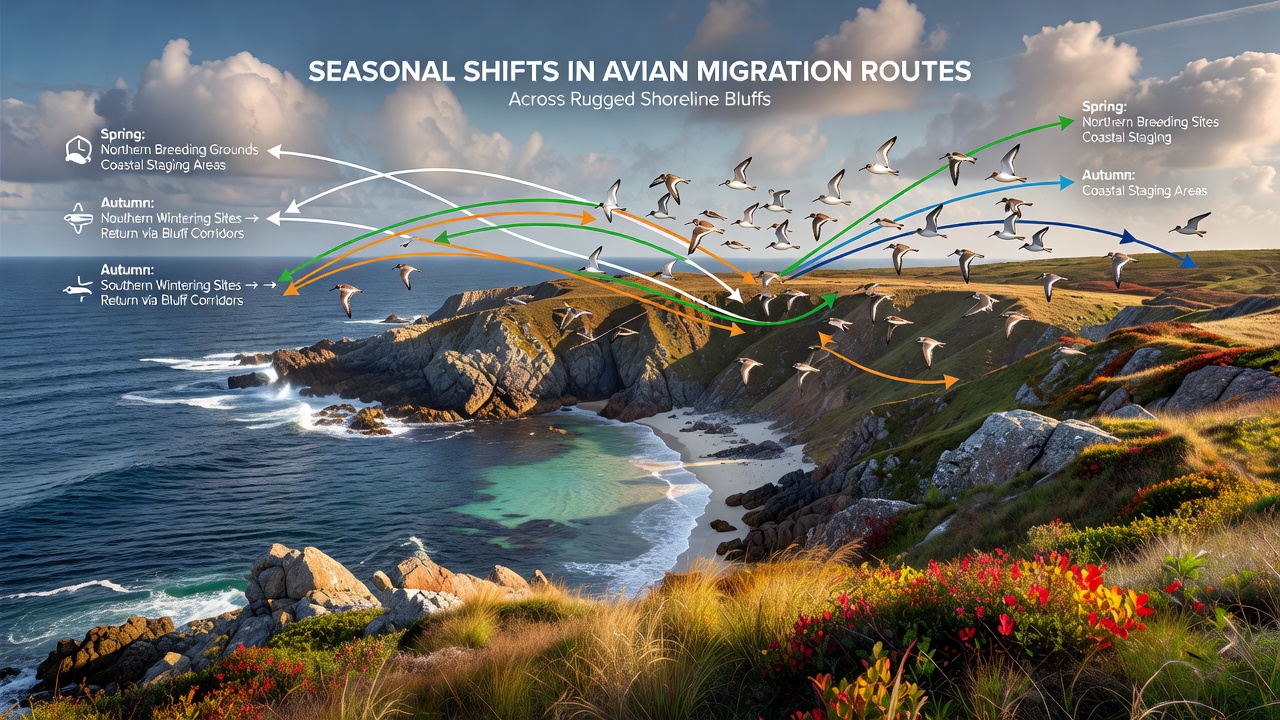
Ornithologists working with satellite tags have recorded individuals altering course by tens of kilometers when encountering unexpected headwinds along bluff lines, and these adjustments accumulate into broader population-level shifts visible in aggregate datasets. According to findings published through US Geological Survey monitoring programs, temperature anomalies recorded during early fall can advance or postpone peak passage dates by up to two weeks in successive years. In parallel, European monitoring networks coordinated through national wildlife agencies have documented similar flexibility among species traveling along Mediterranean and Atlantic cliff systems, underscoring the global nature of these behavioral responses.
Regional Variations and Monitoring Efforts
Along the Pacific Northwest bluffs, counts conducted at fixed observation points show higher volumes of alcids and gulls during September passages compared with interior valleys, while Atlantic sites record stronger representation of terns and gannets that exploit updraft zones created by cliff faces. Australian researchers studying analogous limestone cliffs have noted comparable patterns among seabirds navigating the southern ocean margins, where seasonal wind reversals prompt route changes that mirror those observed in northern hemisphere systems. Data collected across these varied geographies indicate that rugged terrain consistently serves as a navigational aid, with visual landmarks and consistent wind patterns helping birds maintain orientation during long-distance travel.
Technological advances including automated acoustic sensors and high-resolution GPS devices now allow continuous recording of passage rates across previously inaccessible bluff sections, yielding datasets that span multiple decades. These tools have uncovered subtle shifts in altitude selection, with many species flying lower during calm conditions and higher when turbulence increases near cliff edges. Observers note that such behavioral plasticity helps populations maintain connectivity between breeding and wintering grounds despite annual fluctuations in weather and resource distribution.
Conclusion
Long-term records confirm that seasonal shifts in avian migration routes across rugged shoreline bluffs represent adaptive responses to dynamic environmental conditions rather than fixed pathways. Continued monitoring through coordinated international efforts provides essential baseline information that supports conservation planning for species dependent on these coastal corridors. As climate patterns continue to evolve, the flexibility already documented in existing datasets will remain a key factor in species persistence across these distinctive landscapes.