Gisela Keller · 30 September 2026
How Mineral Veins in Vertical Rock Faces Reveal Patterns of Ancient Seismic Activity
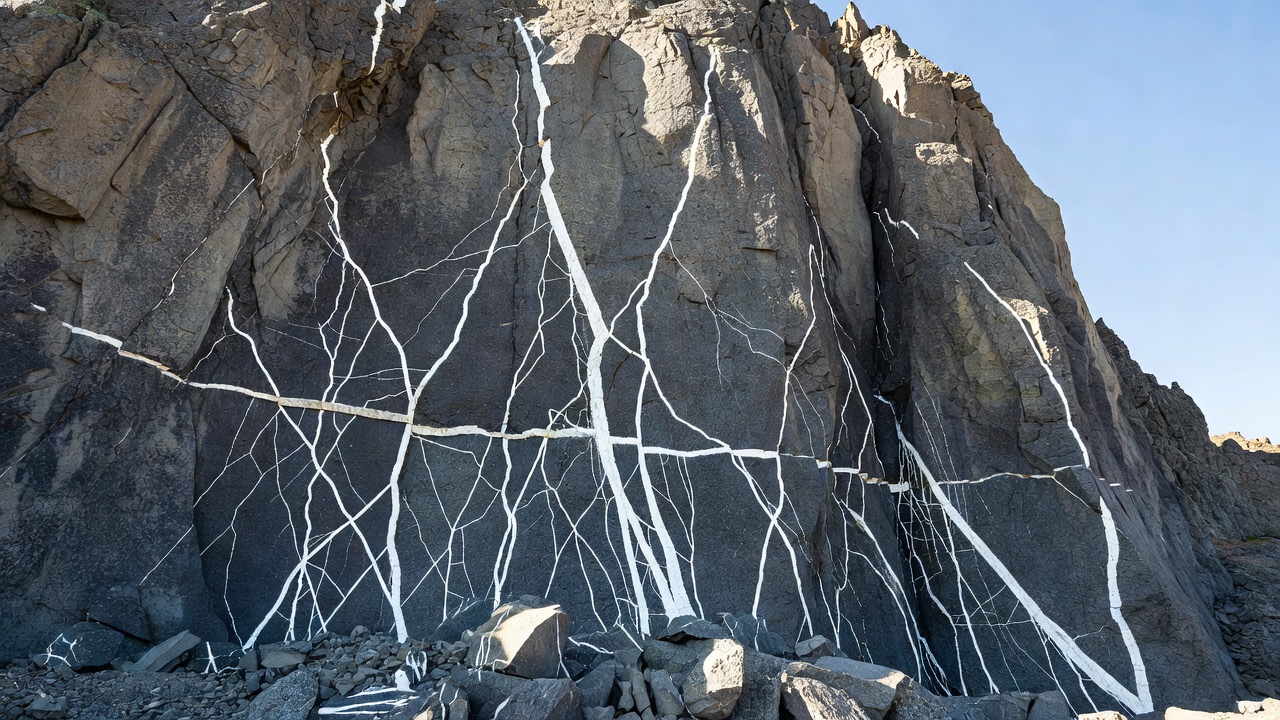
Mineral veins form when fluids fill fractures in rock and deposit minerals over time, and vertical rock faces often preserve these structures in ways that record repeated episodes of movement along faults. Researchers examine the orientation, thickness, and mineral composition of these veins to reconstruct the timing and intensity of ancient earthquakes because each seismic event can create new cracks or reopen existing ones while altering fluid pathways.
Studies of vein systems in regions like the Sierra Nevada and the Scottish Highlands show that veins frequently align with fault planes or form en echelon arrays that indicate shear stress directions during past quakes. Data from field mapping combined with radiometric dating of vein minerals such as quartz and calcite allows geologists to build timelines spanning thousands to millions of years.
Mechanisms Linking Veins to Seismic Events
Earthquakes generate fractures through sudden slip along faults, and these openings fill rapidly with hydrothermal fluids that cool and precipitate minerals under specific pressure and temperature conditions. Vertical exposures reveal cross-cutting relationships where younger veins offset older ones, providing direct evidence of multiple rupture episodes. Observers note that vein textures such as crack-seal bands or breccia clasts often correspond to individual seismic pulses because each event introduces new fluid batches that deposit distinct mineral layers.
According to research from the United States Geological Survey, fluid inclusion analysis within vein minerals can indicate the depth and temperature at which sealing occurred immediately after fault slip. This information helps distinguish between tectonic earthquakes and other fracture-forming processes like cooling contraction in igneous rocks.
Interpreting Patterns on Vertical Faces
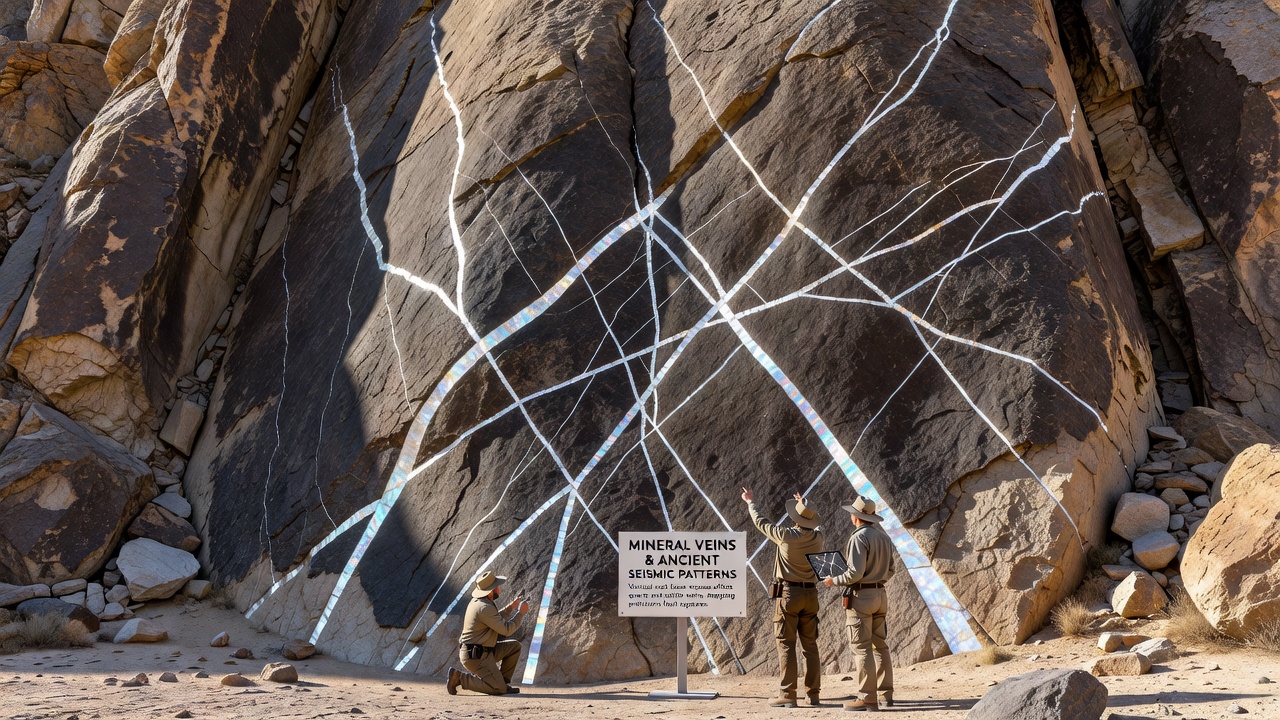
Vertical rock faces expose the full geometry of vein networks because erosion or quarrying removes overlying material and leaves clean sections through the rock. Geologists measure strike, dip, and spacing of veins across these faces to map stress orientations that prevailed during ancient seismic periods. When veins show systematic rotation or curvature near fault zones, the patterns point to changes in the regional stress field between successive earthquakes.
One study from Geoscience Australia documented vein arrays in the Broken Hill region where mineral fillings recorded at least four distinct seismic events over a 50-million-year span, with each generation displaying different rare-earth element signatures that reflect evolving fluid sources. Such findings demonstrate how vertical sections function as archives of paleoseismic history.
Analytical Techniques and Dating Methods
Modern laboratories combine high-resolution imaging with isotopic dating to extract precise timelines from vein minerals. Uranium-lead dating of zircon or monazite within veins, alongside argon-argon analysis of associated alteration minerals, yields ages that correlate with known regional fault activity. Researchers also employ cathodoluminescence microscopy to reveal growth zoning that records individual fluid pulses tied to seismic pumping.
Structural measurements collected from vertical faces feed into three-dimensional models that simulate how stress accumulated and released during past events. These models integrate vein data with fault-slip indicators such as slickenlines to estimate magnitudes of ancient earthquakes, and the approach has proven effective in areas where surface rupture evidence has eroded away.
Regional Examples and Broader Implications
In the Canadian Cordillera, vertical outcrops along the Tintina fault system display mineral veins that record seismic activity from the Late Cretaceous through the Eocene. British Geological Survey mapping in the Scottish Highlands has similarly identified vein sets linked to Devonian fault movements that accompanied the final stages of Caledonian orogeny. These case studies illustrate how vein patterns help fill gaps in the paleoseismic record for regions lacking young sedimentary basins suitable for trenching studies.
Evidence from multiple continents shows that vein-hosted records extend the observable history of fault systems far beyond the reach of instrumental seismology or even historical accounts. The data support refined assessments of long-term fault slip rates and recurrence intervals that inform hazard models for modern infrastructure planning.
Conclusion
Mineral veins preserved in vertical rock faces serve as durable indicators of ancient seismic activity because they capture the physical and chemical signatures of repeated fault slip and fluid flow. Through systematic mapping, mineralogical analysis, and geochronology, researchers reconstruct detailed sequences of past earthquakes across diverse geological settings. Continued fieldwork and laboratory advances continue to expand the temporal and spatial resolution of these records, supplying essential context for understanding the long-term behavior of fault systems worldwide.